
Montgomery County Court Records After Arrest
The arrest-to-court path in Montgomery County runs through Kentucky courts, not through the jail. A person arrested by the sheriff's office, Mt. Sterling Police, Kentucky State Police, or another agency may first be booked at Montgomery County Regional Jail. That booking can create jail and custody records. The court record starts when a complaint, information, indictment, motion, order, plea, or disposition is filed in District Court or Circuit Court.
For custody and booking status, use Montgomery County jail inmate records. For booking photos and photo limits, use Montgomery County jail mugshots. Court records after a jail arrest answer a different question: what charge was filed, what court has it, what date is set, and what the current case status means.
Montgomery County Court Record Contacts
The Kentucky Court of Justice Montgomery County page says circuit court clerks manage Circuit, Family, District, and Business court records. It also says the Office of Circuit Court Clerk in the county is the starting point for case-copy requests from cases heard there. Montgomery Circuit Court Clerk Tanya P. Terry is listed at One Court St., P.O. Box 327, Mt. Sterling, KY 40353. The clerk's phone numbers are 859-498-5966 and 859-498-5991, and public hours are Monday-Friday 8 a.m.-4 p.m.
Montgomery Circuit Clerk
One Court St., P.O. Box 327
Mt. Sterling, KY 40353
859-498-5966
859-498-5991
Monday-Friday 8 a.m.-4 p.m.
Montgomery County Regional Jail
751 Chenault Lane
Mt. Sterling, KY 40353
859-498-8747
Use for current custody after arrest.
Find Court Records After Arrest
The Kentucky Court of Justice docket search is the main online starting point for hearing dates and docket entries. It is a docket tool, not a full case-file download. The docket page warns that it is not an official docket and is subject to change. Case-record copies still route through the circuit clerk because the Administrative Office of the Courts does not maintain the local case files.
- Select Montgomery County in the docket search.
- Choose Circuit or District, depending on the case type or hearing stage.
- Enter the hearing date and narrow by courtroom or subdivision if needed.
- Review the docket entry for name, case number, charge, court division, and scheduled event.
- Contact the Montgomery Circuit Clerk when the docket does not show the document or disposition needed.
The Kentucky Court of Justice request page explains the clerk-first rule for case records.
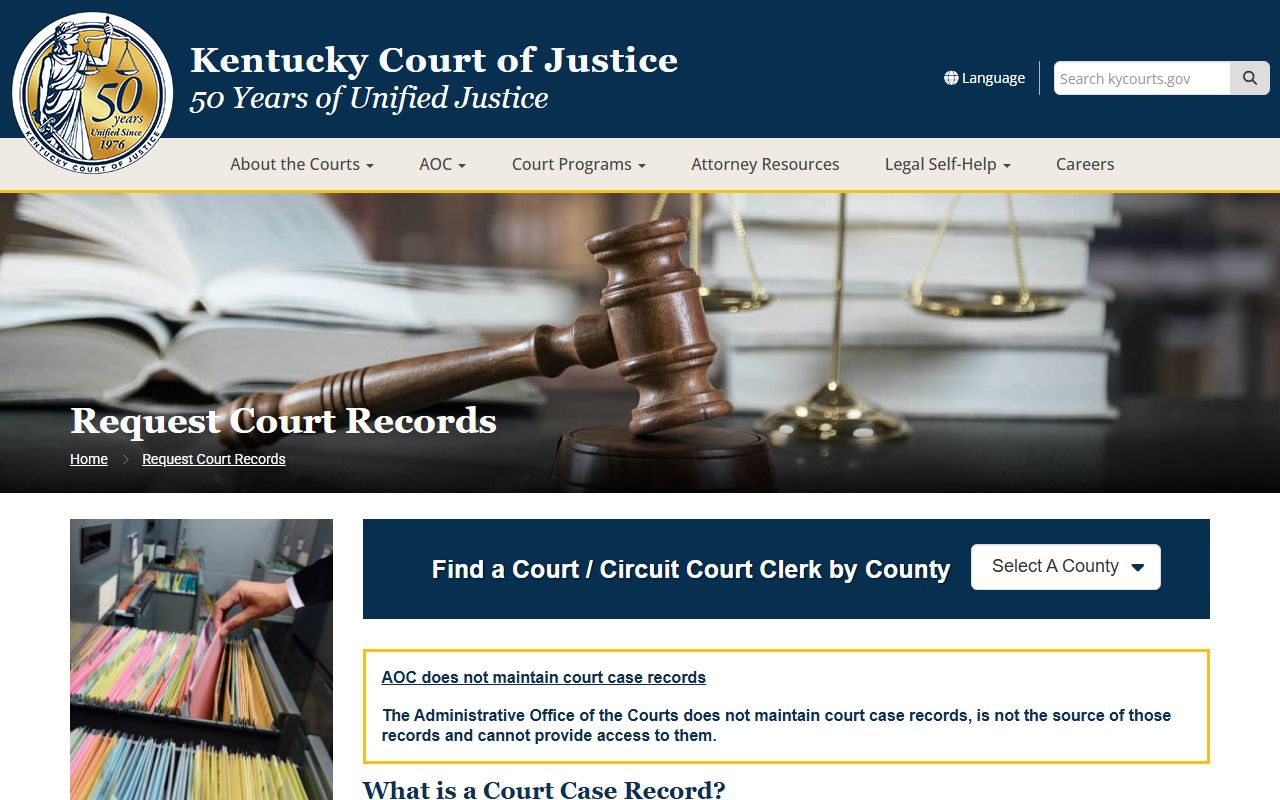
That request process is important when a docket listing proves that a case exists but does not provide a copy of the complaint, order, plea, or final disposition.
Montgomery County Court Search Fields
The official docket-search capture for Kentucky showed a short set of required fields. County, division, and date drive the search. The date requirement means a broad name-only court search may need help from the clerk, a case number, a citation, a jail booking date, or a known arraignment date.
| Field Label | Type | Required | Options / Format Notes |
|---|---|---|---|
| County | Dropdown | Yes | Select Montgomery; observed option value was 0871. |
| Division | Radio button | Yes | Circuit or District, with Circuit observed as preselected. |
| Date | Date picker | Yes | Use the date of the court event or expected docket. |
| Courtroom | Dropdown | No | ALL appears by default. |
| Subdivision | Dropdown | No | ALL appears by default. |
| Submit | Button | Yes | Generates the docket for the selected fields. |
The docket search page itself shows the control set and disclaimer.
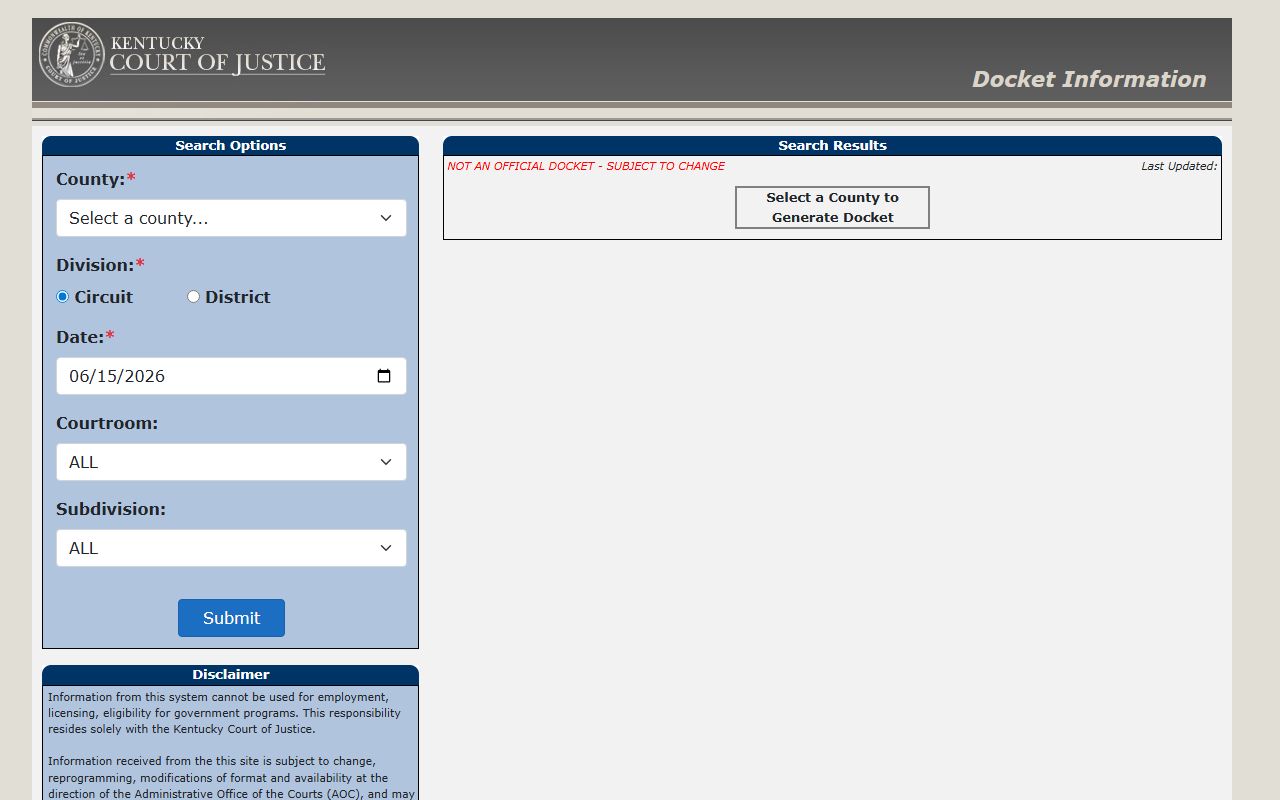
The image reinforces why Montgomery County court records after an arrest often require a date-based docket search or a direct clerk request.
Montgomery County Arrest Court Schedule
Montgomery County is in Kentucky's 21st Judicial Circuit and District. The court page lists separate schedules for Circuit Court and District Court. District Court handles misdemeanor and felony arraignments on Monday and Thursday at 9:30 a.m. It also lists traffic, civil, juvenile, domestic violence, small claims, and probate calendars. Circuit criminal matters appear on separate motion days, and grand jury timing is listed for Circuit Court Division 1.
| Court Event | Published Montgomery Schedule | Why It Matters After Arrest |
|---|---|---|
| District arraignments | Monday and Thursday 9:30 a.m. | Early review of charges and release conditions. |
| District traffic | Monday and Thursday 9:00 a.m. | Traffic offenses tied to a citation or arrest. |
| Circuit criminal Division 1 | Fourth Friday 10:30 a.m. | Felony-level criminal motion setting. |
| Circuit criminal Division 2 | Second Friday 9:00 a.m. | Felony-level criminal motion setting. |
| Grand jury | 2:00 p.m. on listed Division 1 schedule | Potential indictment route for felony charges. |
Charges Filed After Arrest
Booking charges can originate with police or sheriff paperwork. Prosecutors then review the facts and decide what formal charge should be filed, amended, dismissed, or presented to a grand jury. Kentucky uses Commonwealth's Attorneys for felony prosecution at the circuit level and County Attorneys for many misdemeanor, traffic, juvenile, preliminary, and county-level matters. Montgomery County is served by 21st Judicial Circuit Commonwealth's Attorney Ashton McKenzie and County Attorney Keith Craycraft.
| Document | Who Uses It | What It Does |
|---|---|---|
| Complaint | Officer, prosecutor, or court process | Starts or supports a criminal charge based on sworn facts. |
| Information | Prosecutor | Files a formal charge without a grand-jury indictment where allowed. |
| Indictment | Grand jury | Accuses a person of an offense and moves a felony case forward. |
A filed charge is not proof of guilt. It is the court-facing accusation that moves through arraignment, motions, plea talks, trial, dismissal, or sentencing.
Montgomery County Charge Status
Charge status can change after the first court event. A jail lookup may show the arrest or booking charge, while the court file may later show a reduced count, added count, indictment, dismissal, or plea. For that reason, court records after a jail arrest should be checked by case number and date, not only by the first charge named at booking.
| Status | What It Means |
|---|---|
| Pending | The charge remains open and has not reached a final disposition. |
| Amended | The charge text, level, or count has changed by court action. |
| Reduced | The offense level or charged conduct has been lowered. |
| Dismissed | The court has ended that charge without a conviction on it. |
| Indicted | A grand jury has returned a felony charging document. |
| Disposed | The charge has a final court result, such as plea, verdict, dismissal, or sentence. |
Bond After Montgomery County Arrest
Montgomery-specific bond posting instructions were not located on an official jail page. Kentucky courts set release conditions. For a person held after arrest, call Montgomery County Regional Jail with the person's name and date of birth, ask whether release is allowed, and ask where bond must be posted. Then confirm any court payment step with the Montgomery Circuit Clerk. The clerk page lists payment options for court payments, but that should not be treated as jail bond policy without confirmation.
| Bond or Hold | How It Works |
|---|---|
| Cash bond | Money is paid to secure release and future court appearance. |
| Surety bond | A bondsman or surety posts bond where local rules allow it. |
| PR bond | Release is based on a promise to appear, with no money posted up front. |
| No-bond hold | Ordinary bond does not release the person, often due to charge type or another order. |
| Detainer | Another agency wants custody after the local case or release decision. |
Warrants and Court Records
The Montgomery County Sheriff's Office does not publish a searchable active-warrant database in the official sources reviewed. The official warrant-like source found was the MCSO Most Wanted page, which shows highlighted wanted persons and tells the public to contact the sheriff's office or report anonymously. That page is not a full warrant index, and a wanted photo is not a conviction.
Bench warrants and failure-to-appear matters may be tied to District or Circuit Court case records. If a warrant was served and the person was booked, call Montgomery County Regional Jail or check KOOL and VINE. State parole or DOC holds may appear in KOOL. Federal warrant and federal custody questions route through U.S. Marshals or BOP systems.
Charges vs Convictions
Courts use precise stages. An arrest is an accusation and custody event. A charge is a formal allegation. A conviction is a finding or plea that resolves guilt on an offense. Montgomery County court records after a jail arrest may show all three concepts at different points in the same case, so the label on the record should be read with care.
| Record Point | Charge | Conviction |
|---|---|---|
| Stage | Accusation filed in court | Final finding, plea, or verdict |
| Proof level | Based on probable cause or charging decision | Based on plea or proof beyond a reasonable doubt |
| Can change | May be amended, reduced, or dismissed | May be appealed, vacated, or expunged if eligible |
Sealed and Expunged Records
Kentucky open-records law allows public access to many court and jail records, but it also recognizes limits. KRS 61.878 lists exemptions that can cover privacy, law-enforcement, criminal litigation, and security-sensitive records. Juvenile matters, sealed files, confidential victim information, and some active investigative material may not be available through an ordinary public request.
| Issue | Sealed | Expunged |
|---|---|---|
| Public visibility | Hidden or limited by court order | Removed from normal public access if granted |
| Record existence | Still exists with restricted access | Treated under the expungement order and statute |
| Kentucky source | Court order and access rules | KRS 431.073 for eligible felony expungement procedure |
Important: Do not use jail, court, or custody information for employment, housing, credit, insurance, or tenant screening decisions.
Public Access Limits After Arrest
Kentucky residents may inspect public records under KRS 61.872, and KRS 61.874 covers copies, reproduction costs, and electronic access. Those statutes do not make every document instantly available online. Court case records begin with the clerk of the court that heard the case, while DOC offender records route through DOC open records. Jail booking facts should be requested from the jailer or county custodian when they are not provided informally.
Use the right custodian for the right record. The jail confirms custody and booking status. The Montgomery Circuit Clerk handles local court case records. The Commonwealth's Attorney and County Attorney handle prosecution roles but are not substitutes for the clerk's case-file request path. KOOL and VINE are custody tools, not final court-disposition databases.